In an account published on November 11, 2026, ross.wei described Tacit Chain as a payment-focused zk-rollup prototype designed to make in-person crypto payments faster while keeping transaction details private. The proposed test is practical: can someone pay for a coffee without leaving the merchant waiting or exposing their spending history? The account describes a design and makes performance claims; it does not document an independent merchant payment test.

Why use a rollup instead of a payment channel?
The account contrasts several ways to move payments away from a base chain. A federated sidechain can process transfers on a separate ledger, but users depend on its operators and custody arrangements. Lightning instead uses payment channels funded on Bitcoin: participants exchange signed updates before settling on-chain. The account characterizes Lightning as relatively trust-minimized, while noting the need to monitor for attempts to settle using an outdated channel state.

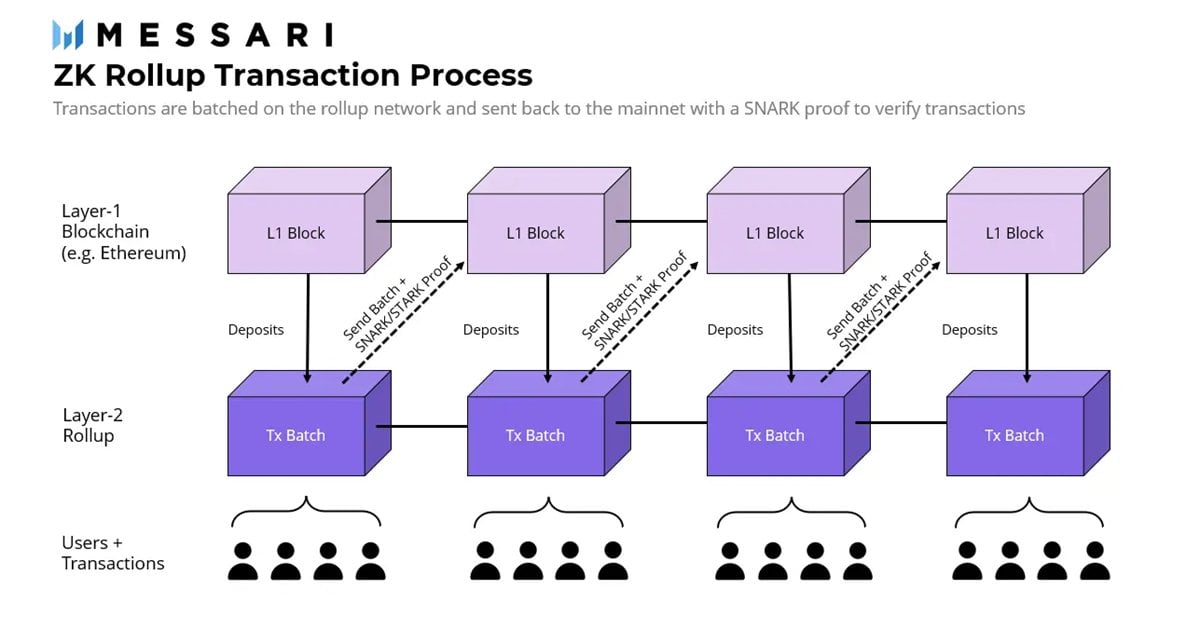
Tacit takes a different route. As a zk-rollup, it would batch payments and submit validity proofs to Ethereum. Unlike an optimistic rollup, whose challenge period can make withdrawals take about a week, this approach checks a proof when the batch is submitted. That difference concerns how the batch is validated; it does not make Tacit a Lightning channel or remove the operational requirements of entering and leaving the rollup.
What happens to a Tacit payment?
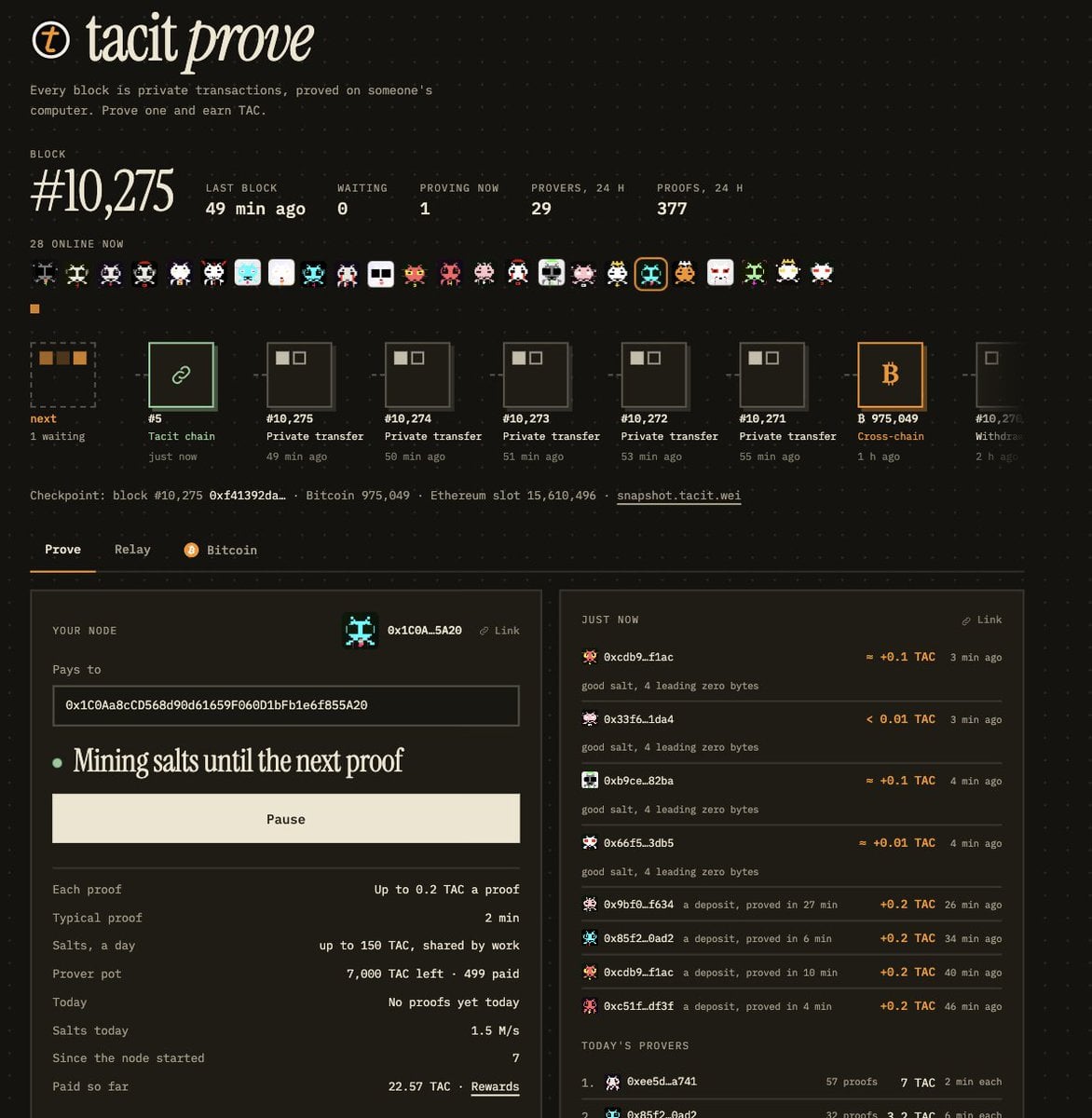
According to ross.wei, a user’s device proves that a payment is valid without revealing the sender, recipient or amount to the rollup verifier. A second proof checks the processed batch before Ethereum accepts it. A rotating leader orders payments and submits blocks to the TacitBlocks.sol contract. The described system gives a holder of a 1,000 TAC seat a scheduled turn; if that leader does not act, anyone can take over after 10 minutes. GPU operators can participate in proof generation and earn TAC under the described reward program.
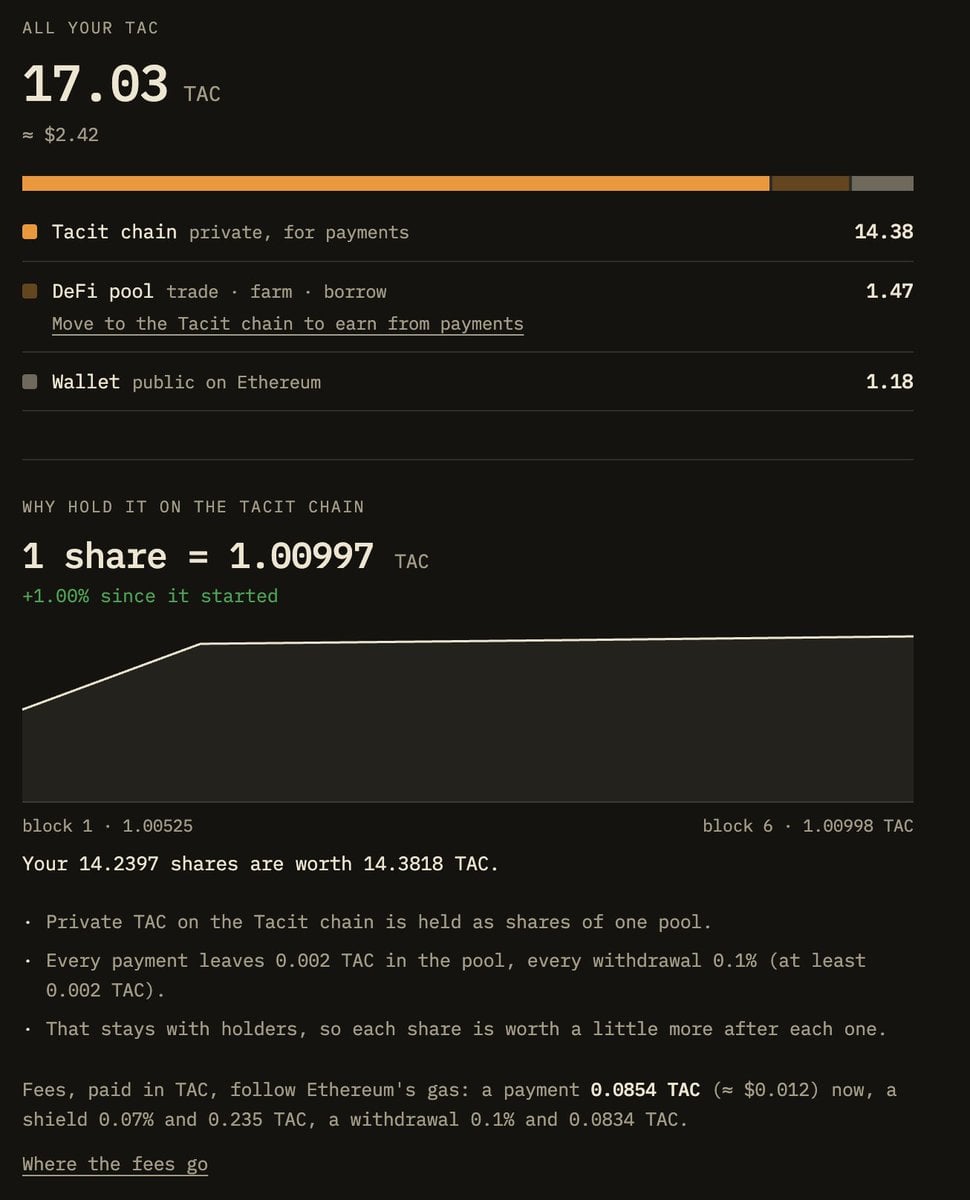
TAC is also used for fees. The account says portions of payment and exit fees remain in a shared pool associated with users’ shares, rather than going to an intermediary. It argues that more payments per batch could lower the Ethereum posting cost per payment. Those are descriptions of the proposed fee mechanics and possible cost effects, not a guarantee of cheaper payments.
Funding, withdrawal and remaining dependencies
The account describes entry from Ethereum, including an EIP-2612 permit route for holders of a TAC airdrop, and routes from Bitcoin through either a liquidity-provider atomic swap described as a fast bridge or a conventional bridge. It proposes shielding TAC and other bridged assets in a privacy pool. These entry routes are distinct from making a payment inside the rollup.
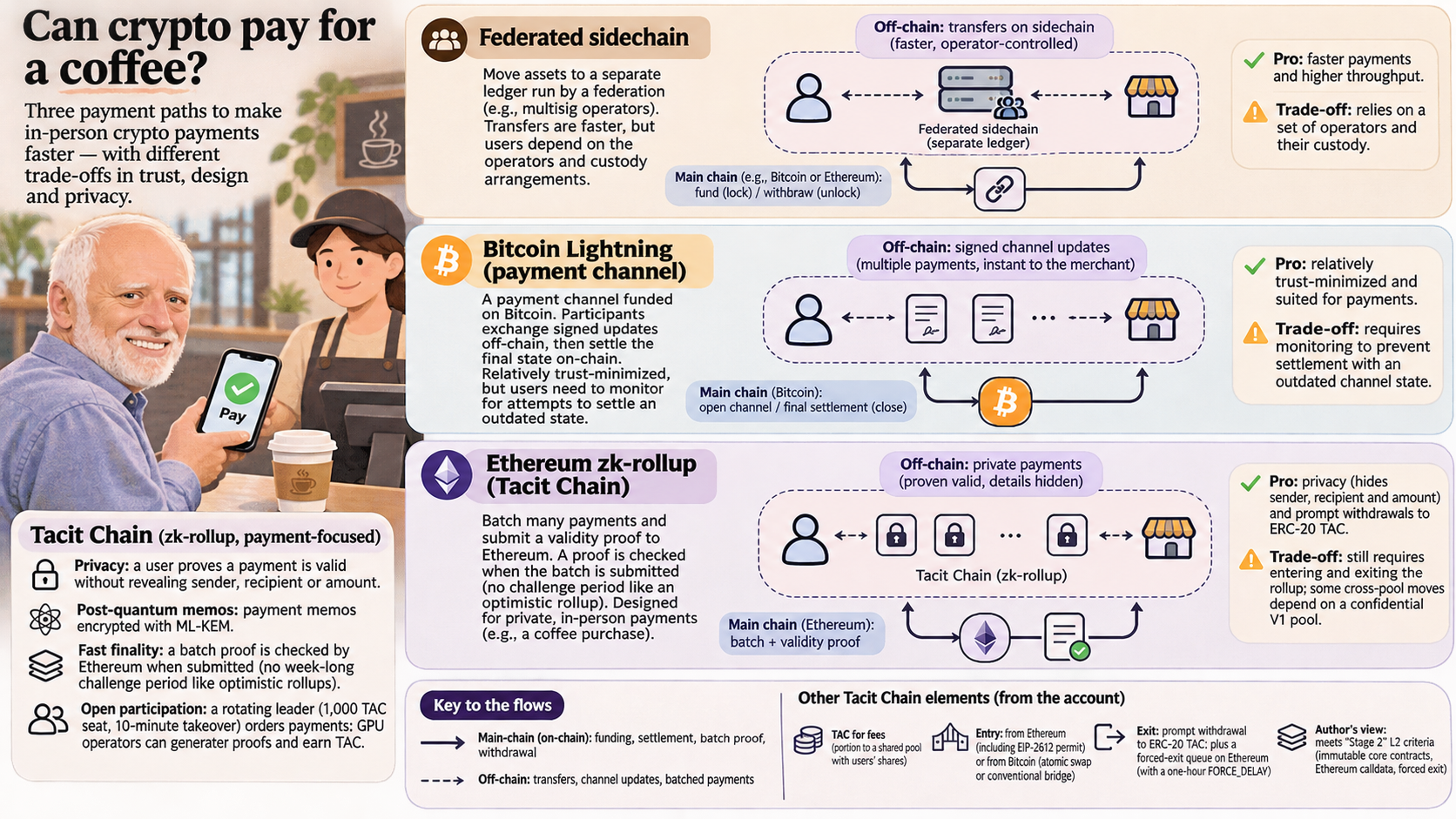
For exit, the account says users can withdraw promptly to ERC-20 TAC. It also describes a forced-exit queue on Ethereum: if a block skips a queued force() item beyond the one-hour FORCE_DELAY, QueueOverdue() causes that block to revert. Cross-pool moves and migrations depend on a confidential V1 pool and therefore on trust in that pool’s construction, the account acknowledges; a withdrawal to Ethereum as TAC does not depend on V1.
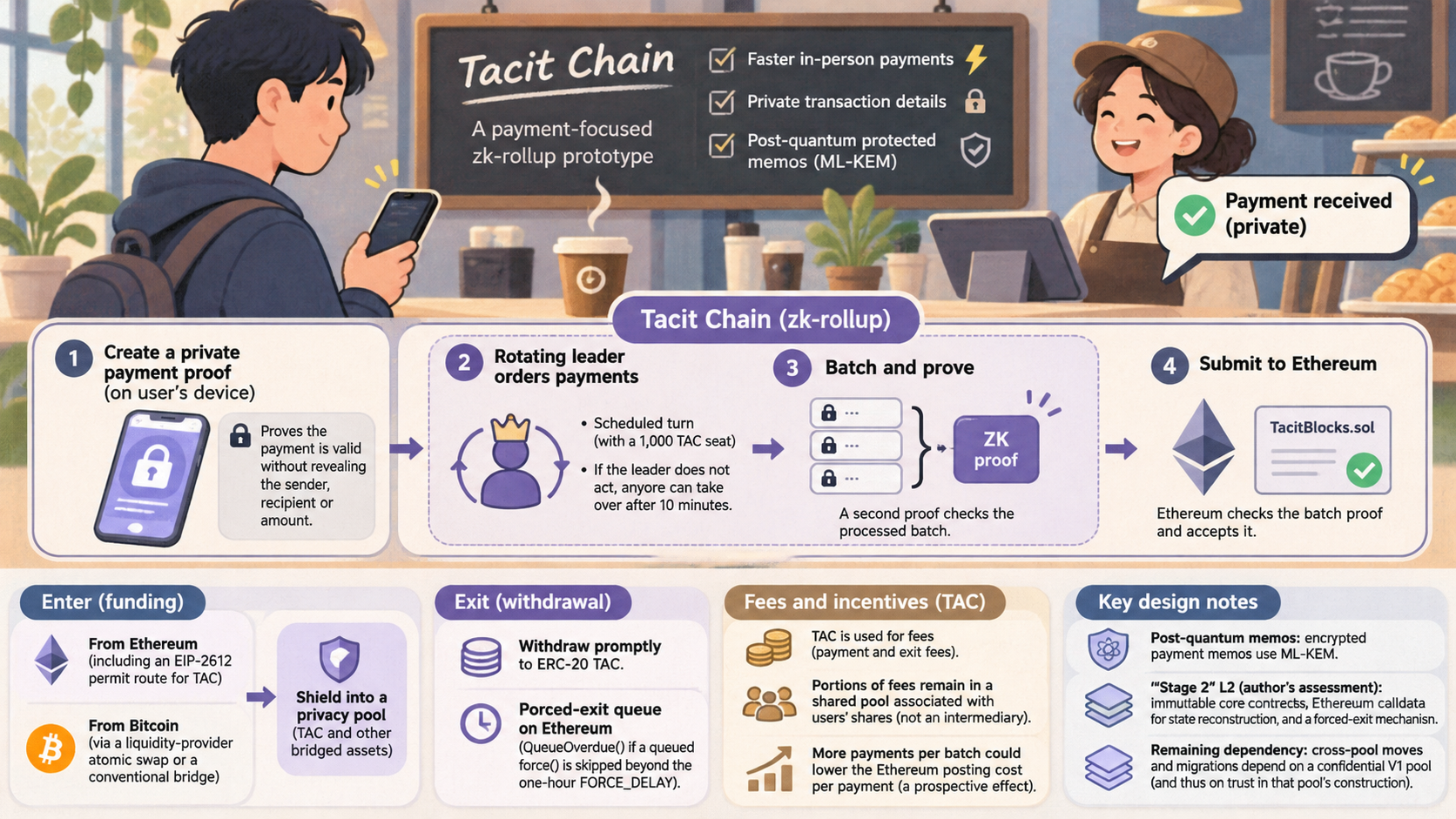
Ross.wei further says encrypted payment memos use ML-KEM to protect their contents against future quantum-computing threats. The author argues that Tacit meets the criteria for a “Stage 2” L2, citing immutable core contracts, Ethereum calldata for state reconstruction and the forced-exit mechanism. That classification is the author’s assessment.
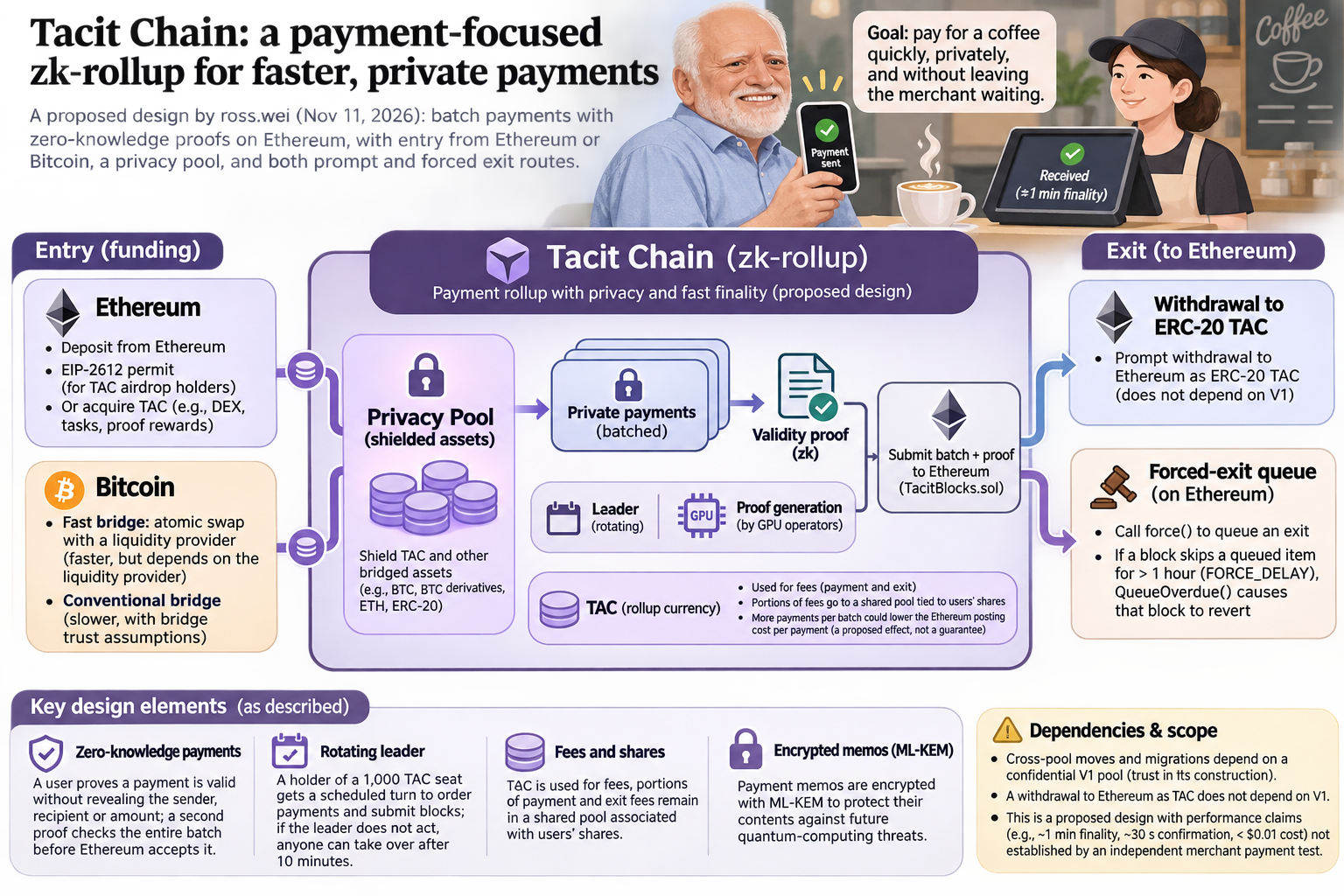
The account claims a merchant can see receipt when a payment is sent and obtain Ethereum finality in about one minute. It presents confirmation nearer 30 seconds and costs below one cent as prospective improvements, not established results. For a merchant, the unresolved practical question is not only when a payment appears, but which asset they receive and how they can withdraw or exchange it; the described options include withdrawing TAC or swapping within the system.