A crypto payment provider may have regulatory authorizations and licensed partners yet still be unable to complete a customer’s payment. In an analysis published on November 18, 2026, 邵嘉碘 argued that the decisive question is whether the customer relationship, asset controls, bank accounts and responsibility for settlement form a workable path—not how many credentials a group can list.
Follow the payment, not the license list
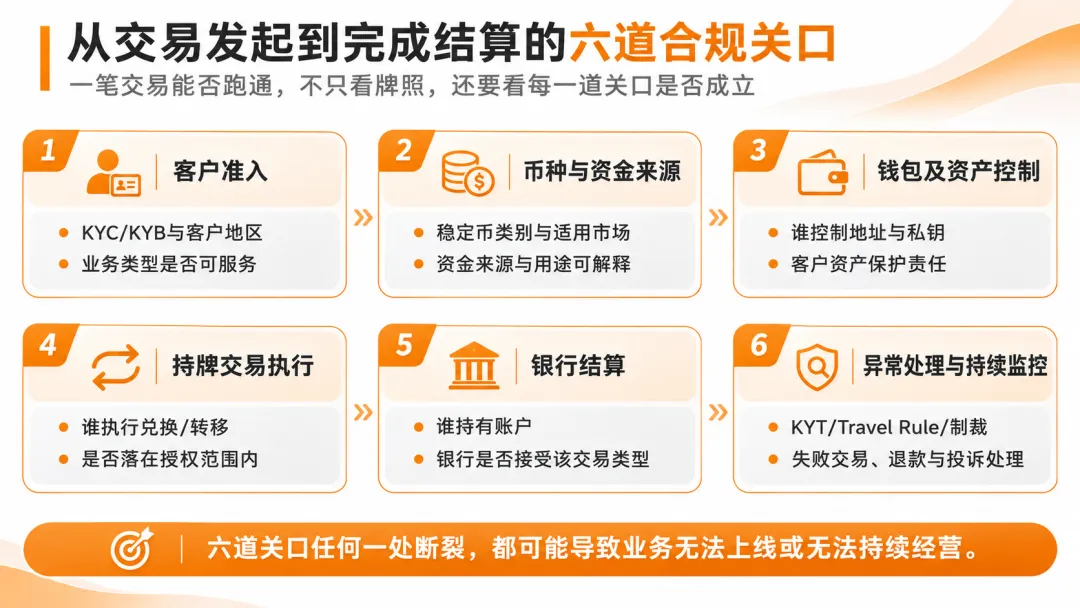
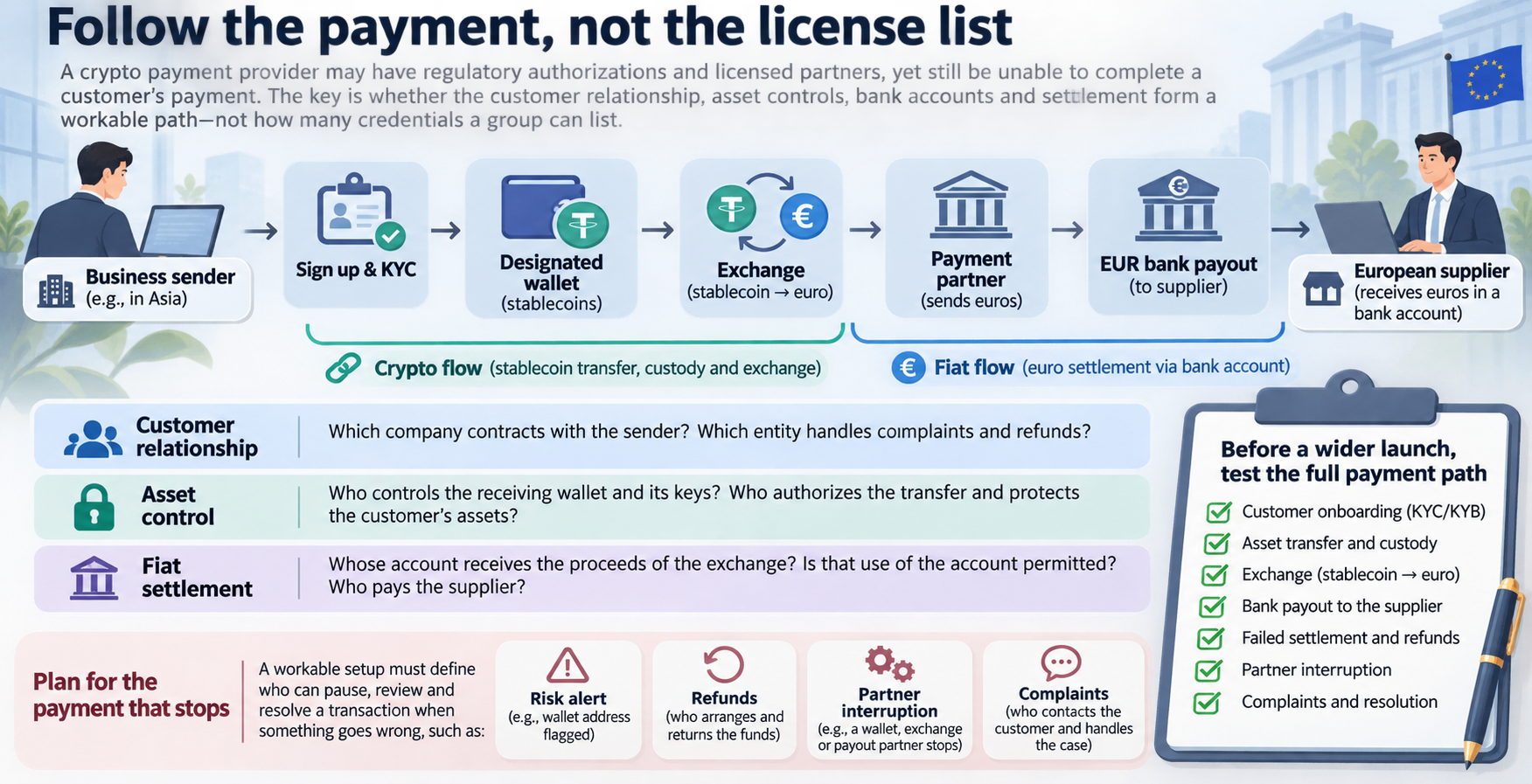
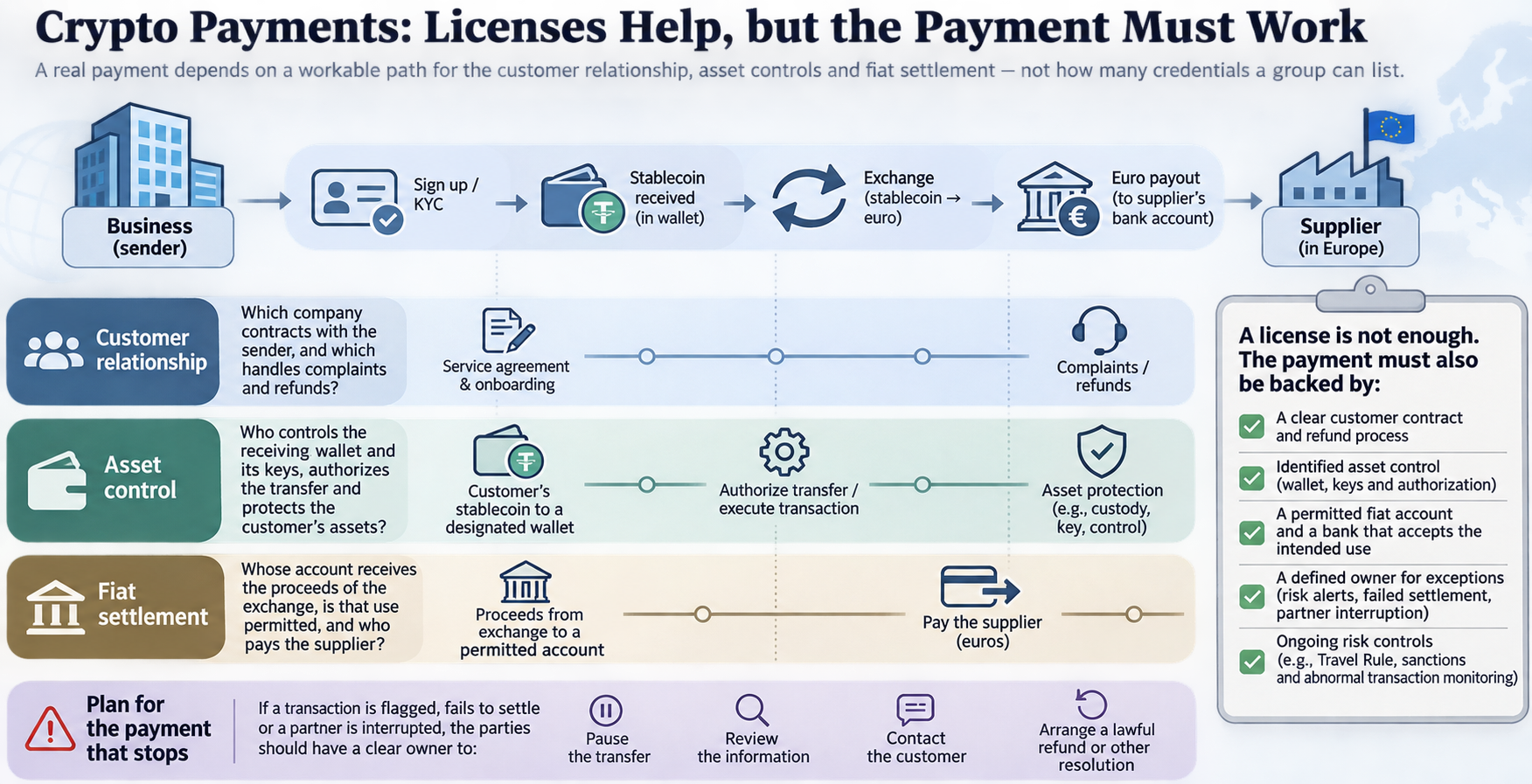
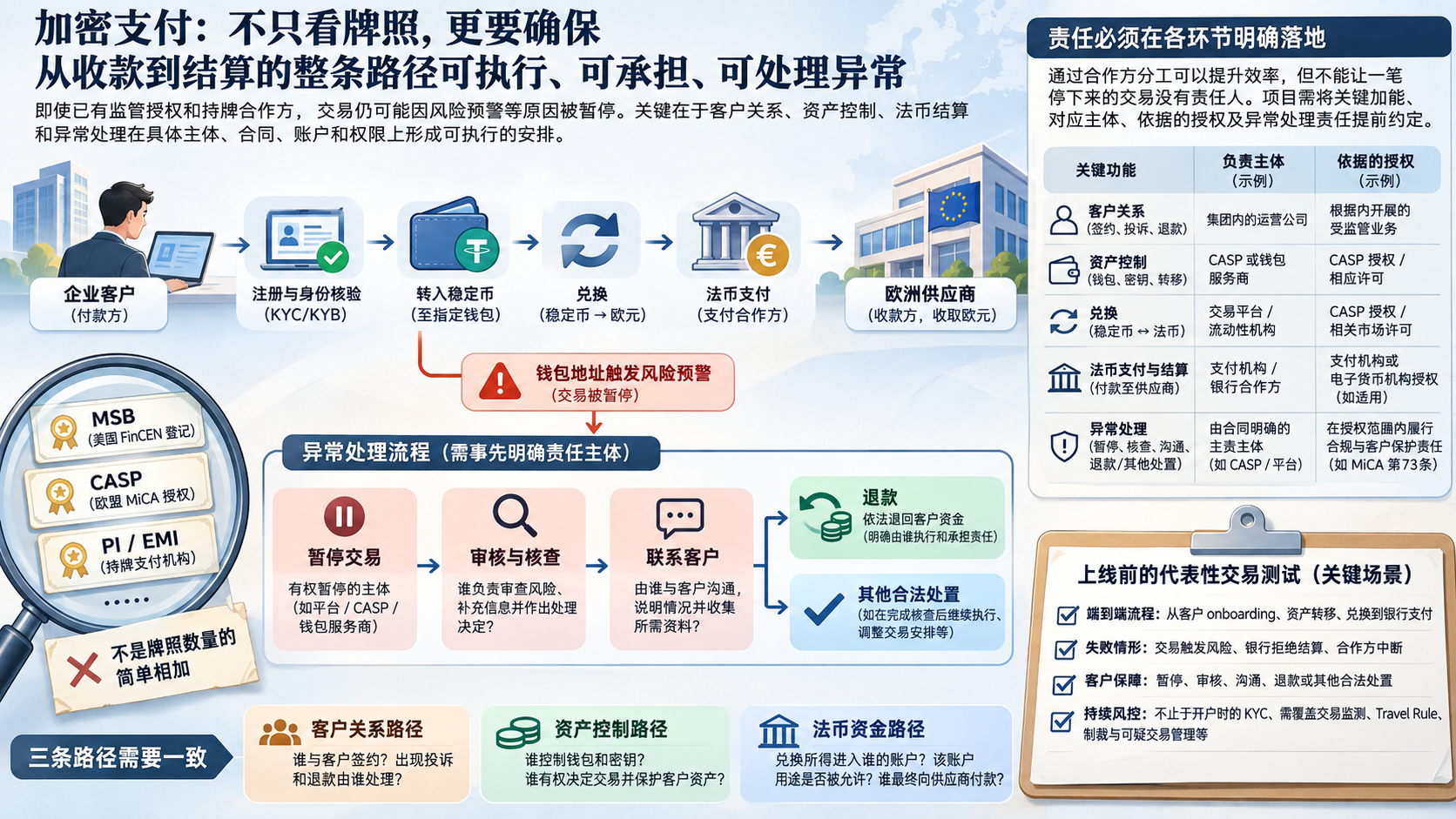
Consider the hypothetical case of a business sending stablecoins to pay a European supplier, who expects to receive euros in a bank account. The sender signs up and completes identity checks; the stablecoins move to a designated wallet; an exchange takes place; and a payment partner sends euros to the supplier.
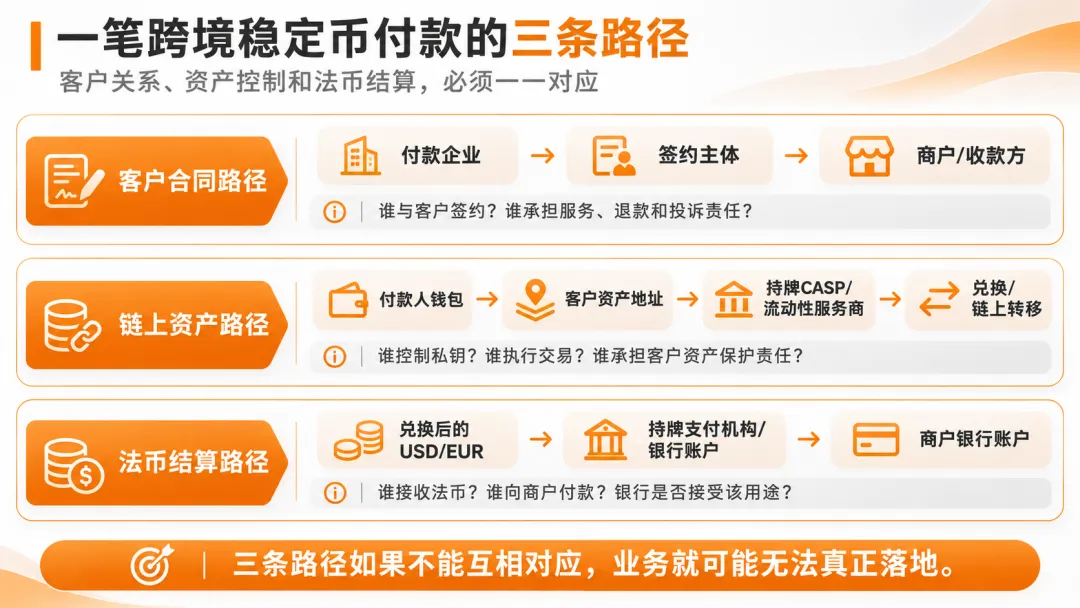
That customer-facing journey conceals three paths that need to agree:
- Customer relationship: Which company contracts with the sender, and which handles complaints and refunds?
- Asset control: Who controls the receiving wallet and its keys, authorizes the transfer and protects the customer’s assets?
- Fiat settlement: Whose account receives the proceeds of the exchange, is that use of the account permitted, and who pays the supplier?
The analysis cautions that a contract describing a company as a technology provider does not settle its regulatory position if that company actually receives customer funds and decides how transactions are executed.
Authorization does not automatically carry across functions
A U.S. FinCEN money services business registration is not a single license for money transmission throughout every state; the activity must also be assessed under relevant state law. An EU crypto-asset service provider, or CASP, can use MiCA’s passporting process after the required cross-border notification, but only for crypto-asset services within its authorization. Passporting does not itself confer the full permissions of a payment institution or electronic money institution.
The analysis also notes that an EBA transition period concerning the interaction between MiCA and PSD2 ended on March 2, 2026. Certain services involving electronic money token transfers and custodial wallets may therefore also need to address payment-service authorization. A provider must map each wallet, custody, exchange, transfer and fiat-payment function to the entity permitted to perform it.
A bank presents a separate constraint. Its willingness to provide an account for payroll and operating expenses does not mean it will accept pooled payments from third-party customers. Even where a provider is licensed, the bank still needs to understand the account’s purpose, the source of funds and the transactions it would support. The analysis notes the EBA’s position that institutions should assess actual customer risk rather than exclude entire categories without sufficient grounds; banks nevertheless retain anti-money-laundering obligations.
Plan for the payment that stops
Using partners for wallets, identity checks, exchange and fiat payout can divide the work, but it cannot leave a stopped transaction without an owner. If a wallet address triggers a risk alert, the parties need to know who can pause the transfer, review the information, contact the customer and arrange a lawful refund or other resolution. Under MiCA Article 73, outsourcing an operational function does not transfer a CASP’s regulatory responsibility or change its relationship with customers or the conditions of its authorization.
The analysis points to FATF’s July 2026 update on virtual-asset regulation, which highlighted concerns including stablecoin misuse, transactions involving self-hosted wallets and difficulties implementing the Travel Rule. Its operational lesson is that an onboarding check alone is not a lasting risk-control process.
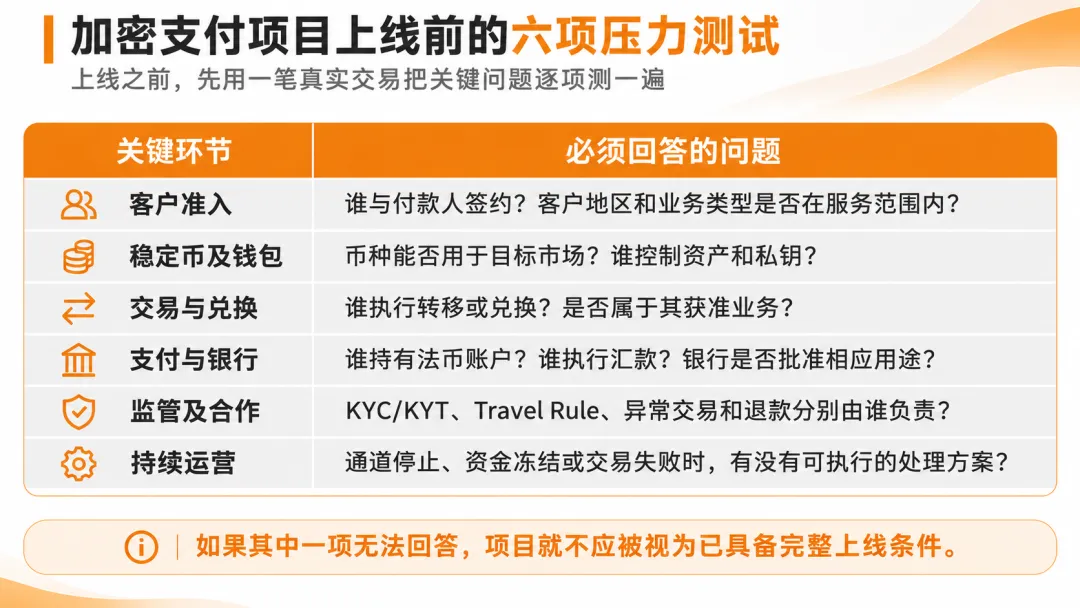
Before a wider launch, the analysis proposes testing a representative transaction under the applicable permitted arrangements—from customer onboarding through asset transfer, exchange and bank payout, including failed settlement, partner interruption, complaints and refunds. A successful test payment is useful, but it does not by itself show that every party can keep the service running or resolve exceptions.