
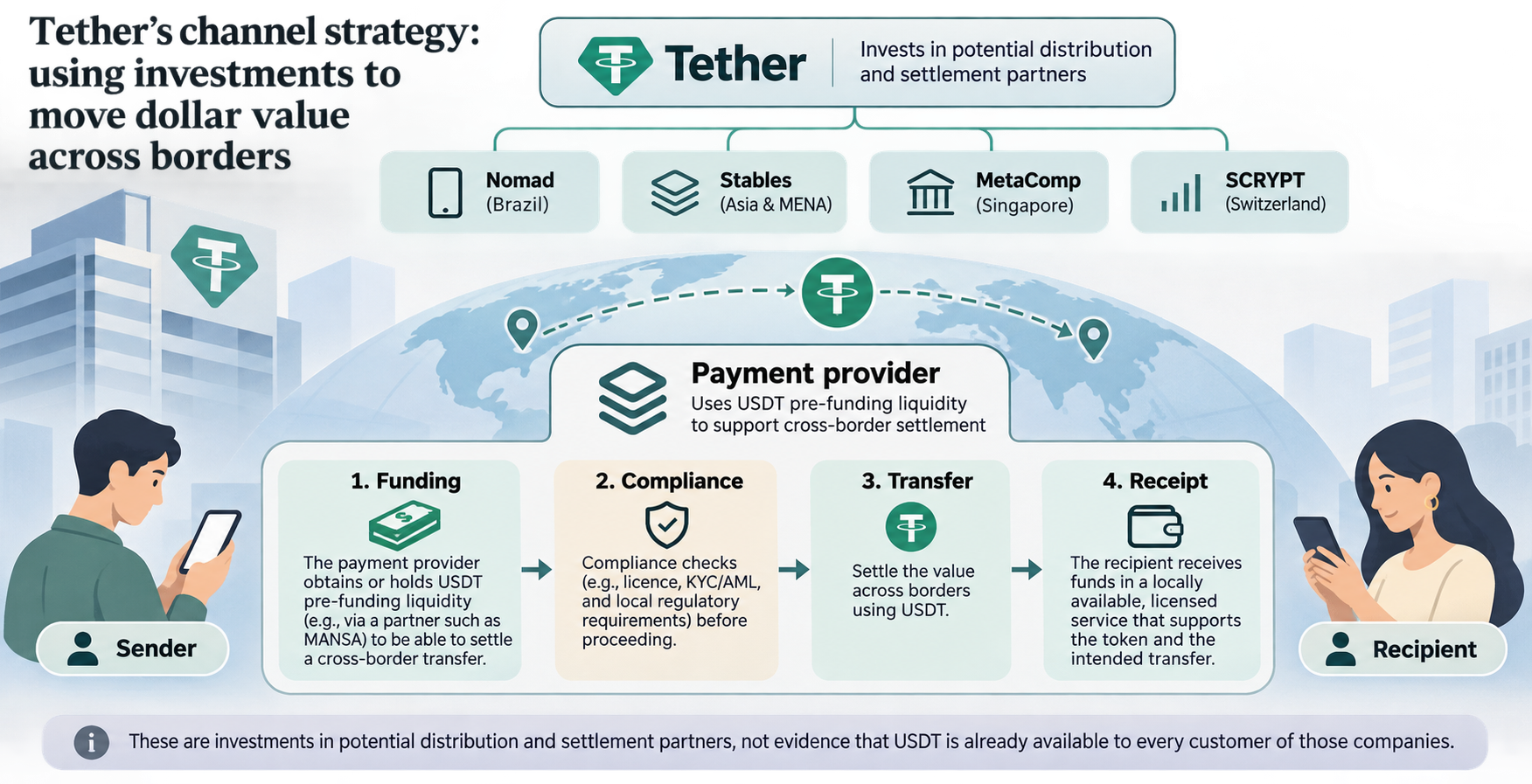
In a report dated November 21, 2026, four Tether investments made between November 16 and 19 pointed to a common strategy: backing companies that could help move dollar-denominated value across borders. None of the deals, however, means USDT is already available to every customer of those companies.
Four investments, different routes
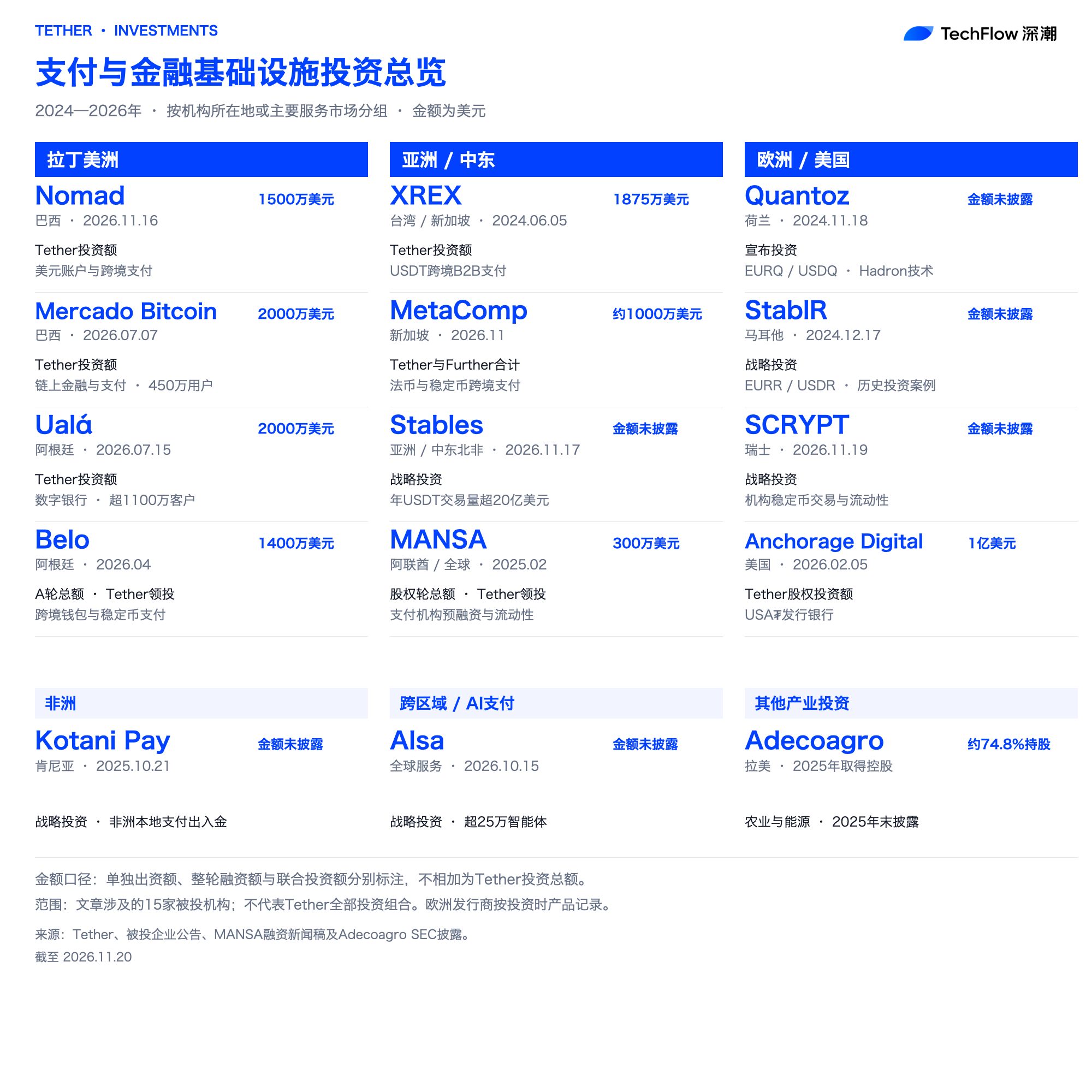
In Brazil, Tether Capital led a Series C round for dollar-account provider Nomad, contributing $15 million to a round totaling 172 million reais. Nomad had 3.8 million customers and managed about 8 billion reais in assets. It was exploring support for USDT and Tether’s gold token XAUT, but had announced no launch date.
Tether also invested in Stables, a payments-infrastructure company handling more than $2 billion in annual USDT transaction volume and focused on Asia and the Middle East and North Africa. In Singapore, Tether and Abu Dhabi-based Further Asset Management invested about $10 million combined in MetaComp, which holds a major payment institution licence. The fourth investment was in SCRYPT, described as one of Switzerland’s largest stablecoin trading and liquidity providers. The reported amounts for the Stables and SCRYPT deals were not specified.
These are investments in potential distribution and settlement partners, not evidence that a Nomad customer can already send USDT or that every partner’s payments use it.
Why distribution matters to Tether
As of September 30, 2026, Tether reported $191.5 billion in reserve assets, including $132.4 billion in US Treasury exposure, and $4.5 billion in net operating profit for the first nine months of the year. The report put USDT issuance at roughly $184 billion over that period. It also cited net profit above $10 billion for the comparable period a year earlier, while noting that net profit and net operating profit are different measures and cannot be directly subtracted to establish a like-for-like decline.
Tether’s earlier investments show the payment-channel approach in practice. In 2024, it invested $18.75 million in XREX for compliant, USDT-based cross-border business payments. In February 2025, it led a $3 million pre-seed round for MANSA, which provides payment companies with USDT pre-funding liquidity. That addresses a specific cross-border constraint: a payment provider may otherwise need to hold funds in multiple locations before it can settle a transfer.
Licences and product availability remain separate questions
A stake in a financial app does not confer permission to offer USDT. The report said Argentina’s Ualá, which has more than 11 million customers, had not integrated the token because of local regulatory restrictions, despite Tether’s reported $20 million participation in its financing. Nomad’s proposed integration was likewise still exploratory.
In Europe, MiCA’s stablecoin provisions began applying on June 30, 2024, and the broader framework took effect on December 30, 2024. USDT had not obtained EU authorisation, and licensed exchanges restricted or removed trading in it. Tether instead backed third-party European issuers, including Quantoz and StablR. In the United States, it made a $100 million strategic investment in Anchorage Digital in February 2026; Anchorage was the issuer of the separately branded USA₮, launched on January 27.
For someone trying to make or receive a payment, the practical distinction is whether a locally available, licensed service actually supports the token and the intended transfer. Tether can invest in those services, but the November 2026 report does not establish when proposed integrations will go live—or whether regulators will permit them.