Reporting published on 24 November 2026 said Base, the Ethereum layer-2 developed by Coinbase, will make quantum security a 2027 priority. Base creator Jesse Pollak told Cointelegraph, in an interview reported on 23 November 2026 and picked up by PANews the next day, that the upcoming Everest upgrade will introduce a new transaction type intended to lay groundwork for quantum-secure wallets.
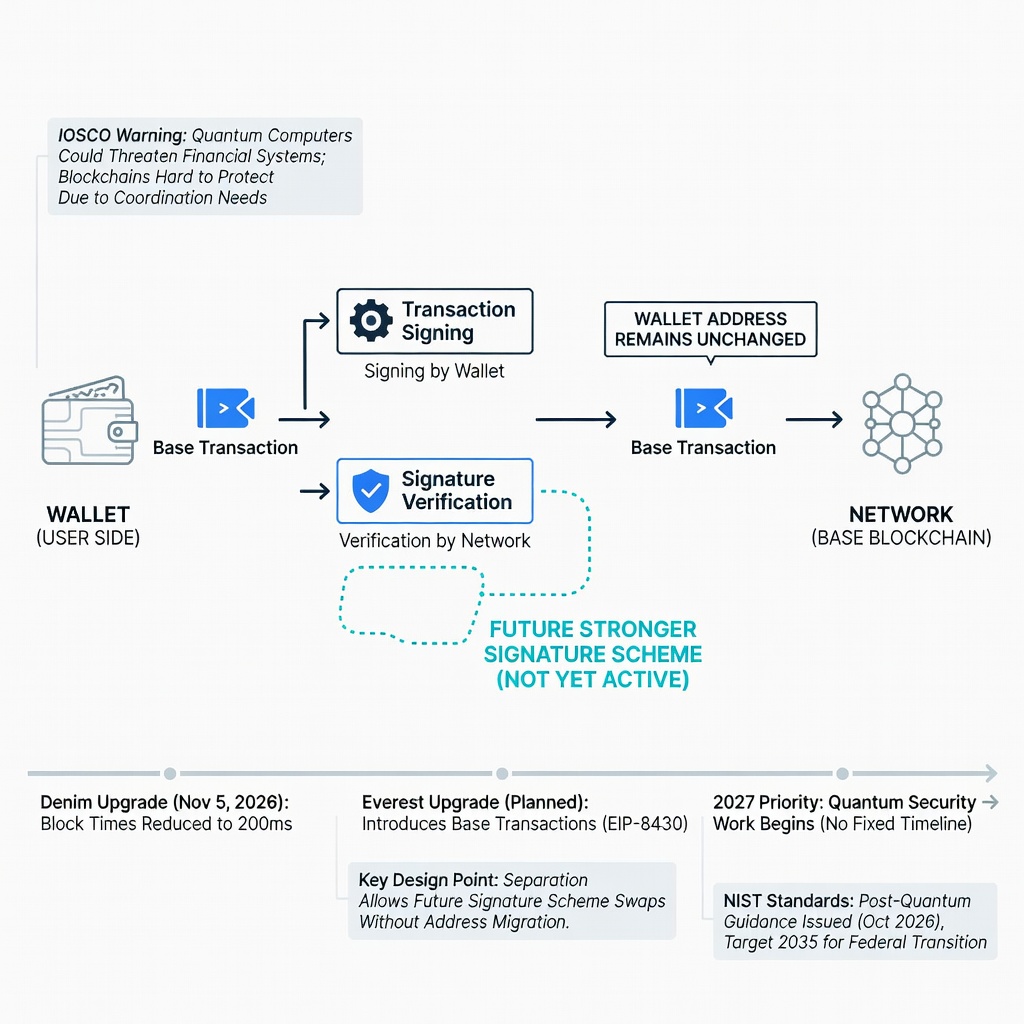
Everest was described as Base’s fifth network upgrade. It is planned to introduce Base Transactions, specified in EIP-8430. That specification still relies on existing cryptography. The change it sets up is a separation between transaction signing and signature verification, so later security methods could be added without users moving to new wallet addresses.
Pollak framed the upgrade as a framework rather than a fix. As reported, Everest would put that structure in place without making wallets quantum-resistant, and Base has not set a timeline beyond prioritising the work in 2027. The team expects to keep working on it after 2027. For someone who already sends or receives funds at a Base address, the reported design point is address continuity: a later change in how signatures are checked would not require a new address. It is not a claim that payments on Base would become quantum-secure, and today’s cryptography would remain in use.
Other 2027 priorities Pollak cited, according to PANews, were expanding trading, payments and lending, and preparing for AI agents to carry out more financial transactions. PANews reported weekly trading volume on Base at $1 billion. DefiLlama data cited in the same coverage put Base second among blockchains by decentralised-finance total value locked, at roughly $5.1 billion.
An earlier change was already live. Cointelegraph reported that Base’s Denim upgrade, rolled out on 5 November 2026, cut block times from two seconds to 200 milliseconds, after which transaction delays briefly affected the network.
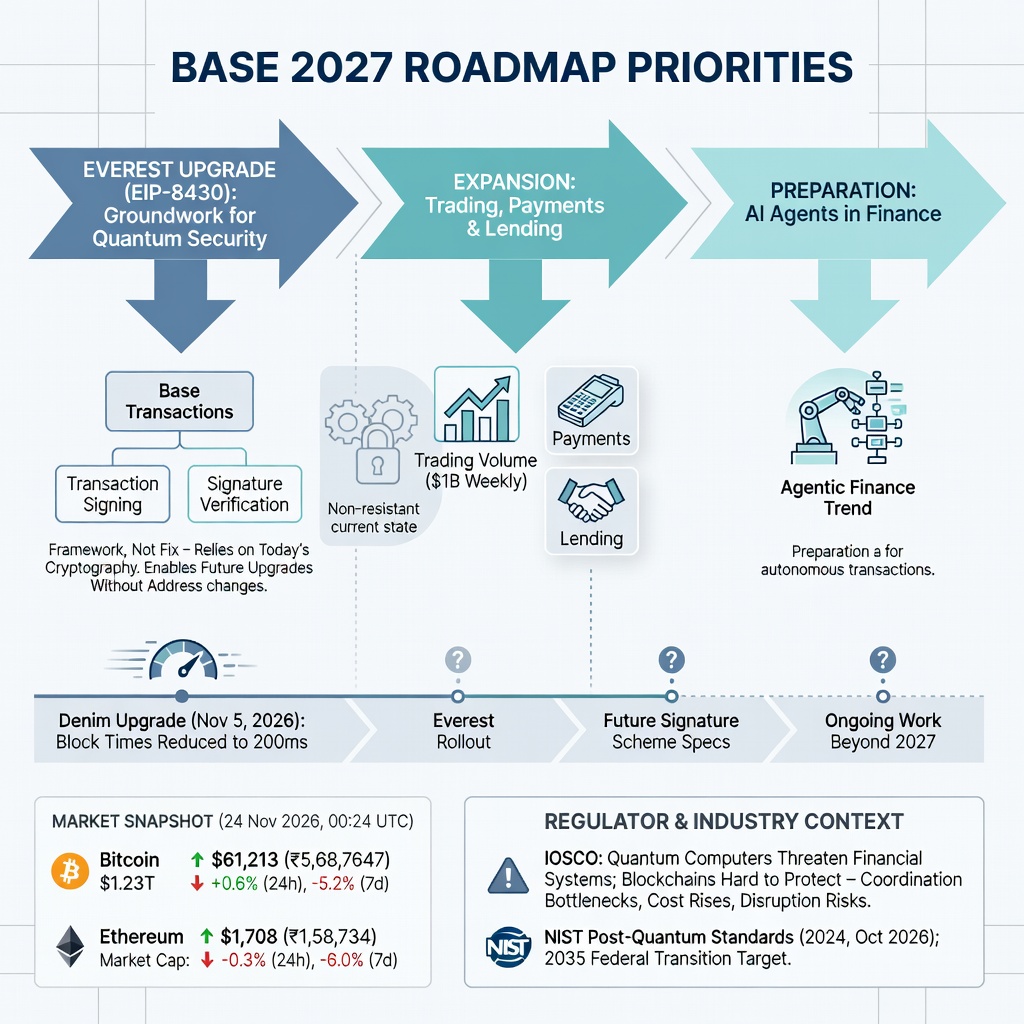
The roadmap was reported alongside regulator warnings. The International Organization of Securities Commissions (IOSCO) warned on Thursday, in the terms of that late-November 2026 coverage, that sufficiently powerful quantum computers could threaten financial systems and that blockchains could be especially hard to protect. The IOSCO report, as summarised, said post-quantum upgrades are slower and more coordination-heavy than in conventional systems because many participants must adopt the change. It also cautioned that such migrations can raise costs, disrupt transactions and create new security issues of their own, and that advances in AI could make cyberattacks harder to detect and analyse.
Standards work outside Base was already on a longer clock. According to Cointelegraph, the US National Institute of Standards and Technology released its first three post-quantum security standards in 2024 and issued further guidance in October 2026, with 2035 set as the primary target for completing the transition across federal systems.
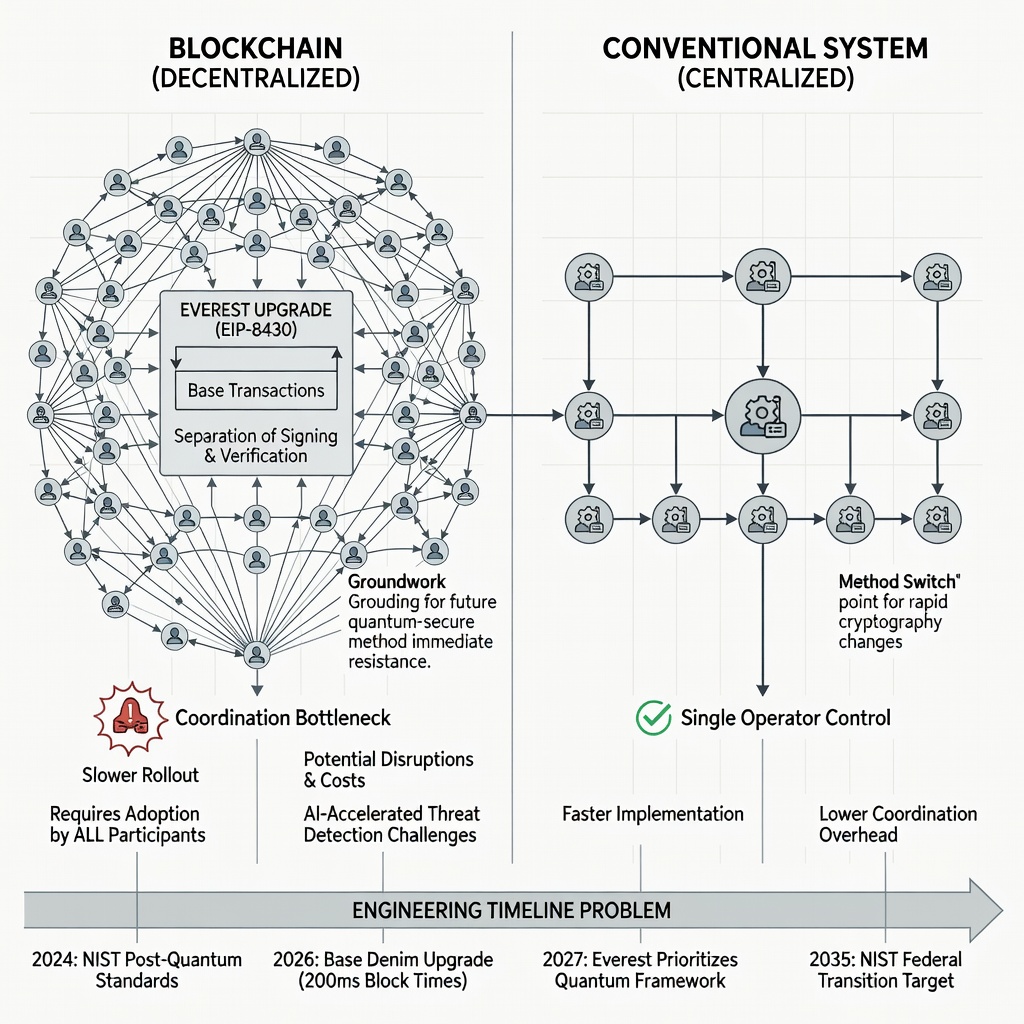
The coverage treated the issue as an engineering schedule. Signature changes take years to design, test and roll out. Base’s reported decision is to build an upgrade path now that is not quantum-resistant today, so a future migration might avoid forcing users off existing addresses. Checkpoints left open in the reporting were the Everest rollout itself, any later Base specification for replacing signature schemes, and whether the work is ever tied to an explicit deadline. Pollak’s statement, as reported, was that no timeline exists beyond making the work a 2027 priority.
At the time of that writing, CoinPaprika data at 24 November 2026, 00:24 UTC, put Bitcoin at $61,213 (₹5,687,647), up 0.6% over 24 hours and down 5.2% over seven days, with a market cap of $1.23 trillion. Ethereum was at $1,708 (₹158,734), down 0.3% on the day and 6.0% over the week. Those were observed prices beside the roadmap story, not a stated effect of the Everest plan.