A November 14, 2026 report described a shift in how Airwallex CEO Jack Zhang approached stablecoins. In June 2025, Zhang publicly questioned whether they reduced cross-border payment costs, arguing that converting stablecoins back into fiat could cost more than using the traditional interbank foreign-exchange market. He did, however, acknowledge a potential role for stablecoin wallets in emerging-market payments.
On November 10, 2026, blockchain project Alta announced a $47.5 million Series A round, bringing its reported funding to $80 million including a $32.5 million seed round. Zhang was named among its co-founders. The distinction for payments is that Alta is aimed at institutional settlement, not at making every customer’s currency conversion cheaper.
What Alta proposes
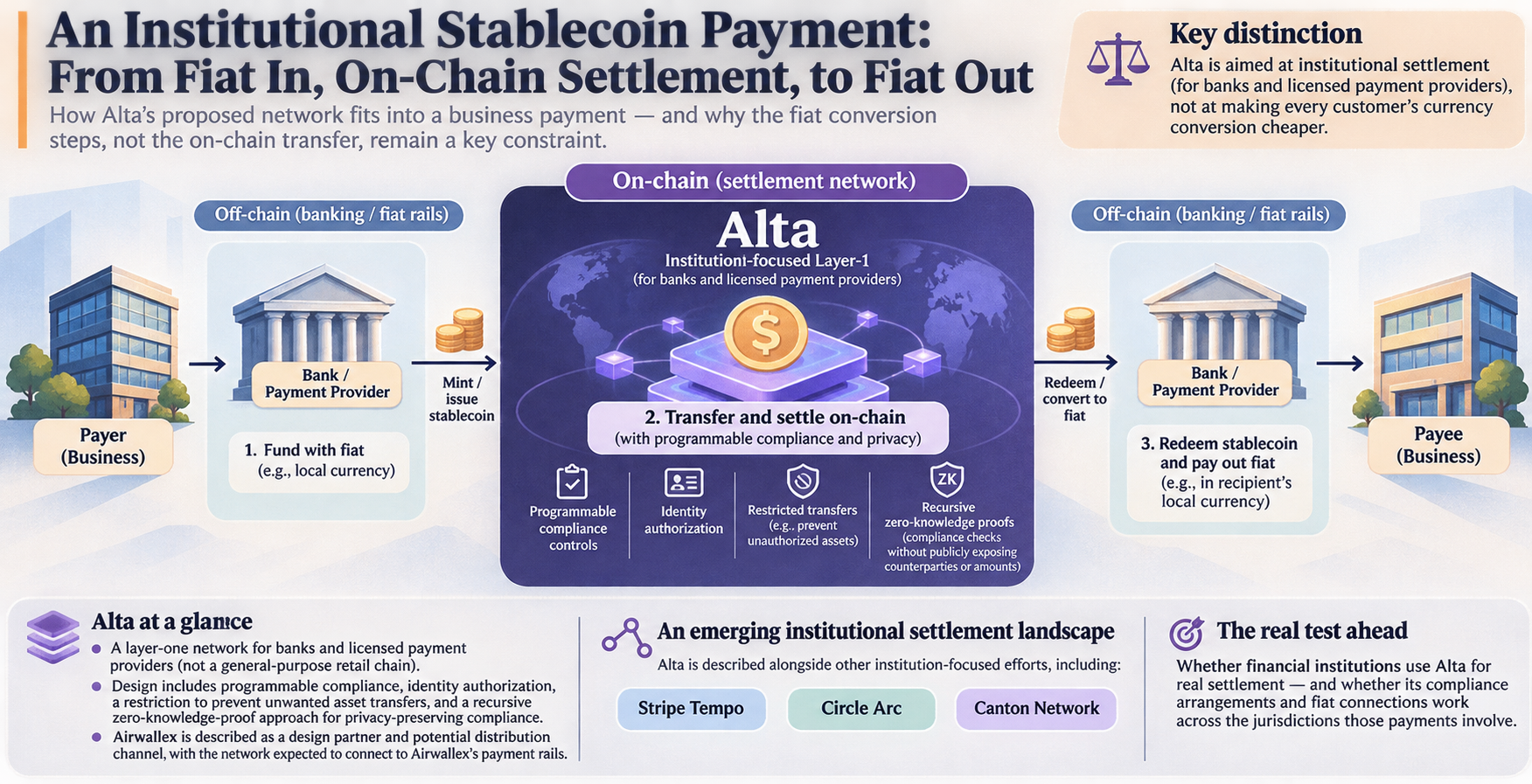
Alta describes itself as a layer-one network for banks and licensed payment providers rather than a general-purpose chain for retail users. The report says its design includes programmable compliance controls, identity authorization and a restriction intended to prevent unauthorized addresses from sending users unwanted assets. It also describes a recursive zero-knowledge-proof approach intended to allow compliance checks without publicly exposing counterparties or transaction amounts. Those are proposed capabilities, not evidence that institutions have adopted the network at scale.
Airwallex is described as a design partner and potential distribution channel. The report says Alta’s network is expected to connect with Airwallex’s payment rails, but it does not establish that Airwallex customers have moved their core settlement activity onto Alta.
The payment constraint remains off-chain
For a business payment, completing an on-chain transfer would be only one step. A recipient who needs local currency must still be able to redeem the stablecoin and receive funds through banking or other fiat payment rails. The cost and availability of that conversion are the very issues Zhang raised in 2025; a new settlement chain alone does not resolve them.
The report places Alta alongside other institution-focused efforts, including Stripe’s Tempo, Circle’s Arc and Canton Network. It argues that Alta’s practical test will be whether financial institutions use it for real settlement—and whether its compliance arrangements and fiat connections work across the jurisdictions those payments involve.