Yapı Kredi, one of Türkiye’s largest private banks, will use Ripple Custody to hold and manage digital assets for Yapı Kredi Kripto, the group’s trading platform. In its November 25, 2026 announcement, Ripple said the system would run on the bank’s own premises. Yapı Kredi will act as custodian; Ripple supplies the technology.
Türkiye’s Capital Markets Board introduced rules for crypto service providers in 2024 that require trading platforms to keep at least 95% of customer crypto with an authorized custodian. Yapı Kredi received approval from the regulator to act as a crypto custodian in 2026. Ripple said its technology was in use at every leading Turkish bank licensed for crypto custody as of the announcement.
XRP trading against the lira slows
Ripple described Türkiye as the largest retail crypto market in the Middle East and Africa and said XRP was among the country’s most widely held digital assets. Holdings and trading volume measure different things: the custody deal concerns where assets are held, while exchange data show how much XRP changed hands.
Coinspeaker’s analysis of Binance data put XRP trading against the Turkish lira at $113 million through November 25, compared with $475 million for all of November 2025. At that pace, the November 2026 total would reach about $136 million, roughly 70% below the year-earlier figure. That was a projection, not a final monthly total. Volume had reached $461 million in February and $375 million in September.
Over the 30 days to November 25, XRP accounted for 1.7% of Binance’s lira trading volume, ranking 11th. It ranked fifth across Binance’s dollar-stablecoin pairs, with a 3.3% share. On Turkish exchange BtcTurk, XRP also ranked 11th by lira volume on November 24.
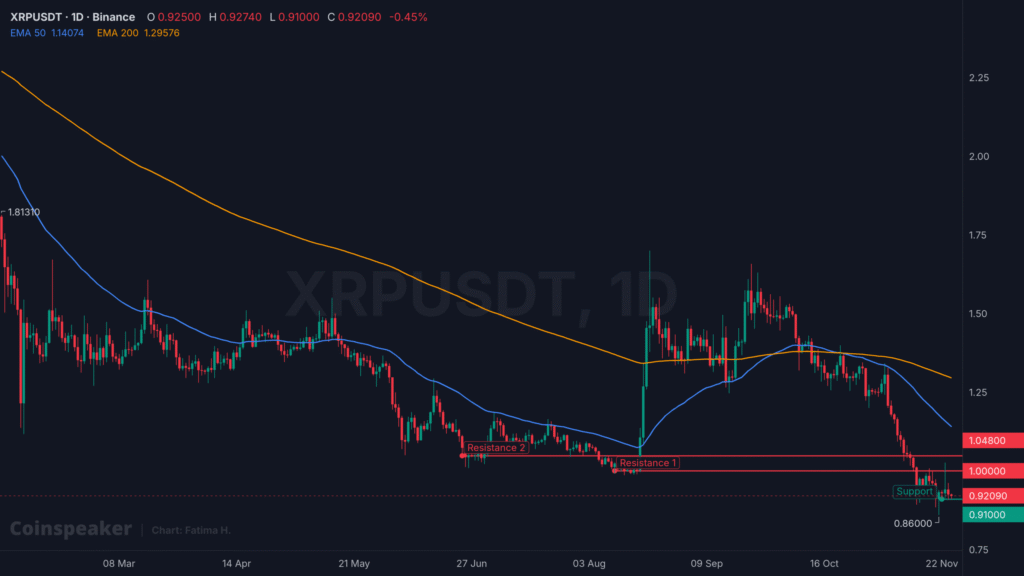
XRP traded at $0.9209 on November 25, down 58% in dollar terms over the preceding year. Its decline was smaller in lira terms, at 50%, as the lira itself lost 16% against the dollar. XRP remained below its 50-day and 200-day exponential moving averages of $1.14 and $1.30, respectively. It had failed to regain $1 on November 18 and 23, while daily lows had held at or above $0.91 for four consecutive days.